PHA
599: Clinical Research APPE Presentation
Guidelines
Purpose
of Assignment
The
purpose of this presentation is to educate your peers regarding the background,
objective, hypothesis, methods and discussion of the research you have been involved
in during this clerkship. Your
presentation should include a background on prior research in the area
including a discussion of the relevance of the research to clinical practice. The presentation should not focus on or
include discussion of your investigative process into prior research or any IRB
approval process that was necessary to conduct the research. Your presentation is an individual effort and
should last approximately 30 minutes, plus an additional 15 minutes for
questions. A grade reduction will be
incurred for failure to adhere to time limits.
A handout including references needs to be provided to both preceptors
and clerkship students.
General
Structure of Presentation
·
Background: approximately first ¼ to 1/3 of presentation
o
Reason
for conducting the research/clinical question
o
Relevance
to clinical practice
o
Prior
research and information related to the topic
o
Study
objective/purpose
o
Study
hypothesis
·
Methods: approximately next ¼ to 1/3 of presentation
o
IRB
approval necessary and if so has it been obtained?
o
Study
design considerations; rationale for design chosen
o
Study
population and rationale for choice
o
Inclusion/exclusion
criteria; discuss rationale for each
o
Treatment
regimen(s)
o
Primary/secondary
outcomes chosen and rationale
o
Discussion
of specific definitions utilized
o
Discussion
of specific laboratory analysis/procedures utilized (i.e. standardized) and
rationale
o
Data
collection/extraction; challenges and how they have been (or will be) addressed
o
Statistical
analysis
1. Tests considered;
those chosen and why
2. A prior alpha
and beta levels and rationale for choices
3. Estimated
incidence of primary outcome and rationale for choice
4. Sample size
estimate
·
Results
(if applicable): approximately next ¼ of
presentation
o
Study
group characteristics; are the groups well-balanced?
o
Primary
results; statistical significance?; discuss any wide confidence intervals and
their implications
o
Secondary
results
·
Discussion: approximately last ¼ to 1/3 of presentation
o
If
results finalized:
1. Interpretation
of results
2. Clinical relevance
3. Comparison to results
of prior studies
4. Unexpected
findings and their implications
o
Potential
relevance of study results to clinical practice
o
Comparison
to prior studies; objectives, study populations, methods, outcomes, definitions,
statistical analyses, etc.
o
Study
limitations and their (potential) impact on results
·
Conclusion
(if applicable)
Tips
for your PowerPoint® Slides
·
Avoid
using multi-color backgrounds and backgrounds with animation; stick to solid
shades or patterns of blue, black or white
·
Limit
the number of lines of text per slide to no more than 10
·
Do
not put ALL your information on the slides (helps avoid reading off slides)
·
If
putting an item such as a chart, table, picture, etc. onto a slide make sure
your audience can read it. Print out the
individual slide in landscape orientation, place it on the floor, and stand
over it….If you can’t read it while
standing over it your audience won’t be able to read the projected image.
·
Create
tables, charts or graphs to summarize large amounts of information
·
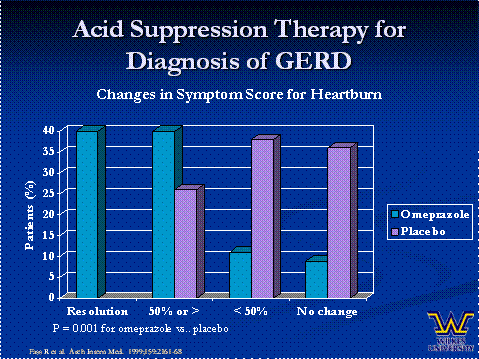
Include
abbreviated citations at the bottom of slides containing published information
(i.e. trial results, etc.); see example below:
Fass R et
al. Arch Intern
Med. 1999;159:2161-68


·
Do
not list your references on your final slide(s); include them on your handout
(see “Tips for your handout” below)
·
After
your final slide create slides for anticipated questions (i.e. “gunner” slides)
that are not part of your planned presentation.
Tips
for your handout
·
The
purpose of the handout is to serve as a reference tool
·
The
handout should be a summary of information that is presented; you may print out
your slides as a handout
·
Using
a word processor program list full reference citations according to the National
Library of Medicine guidelines in the order they appeared throughout the
presentation