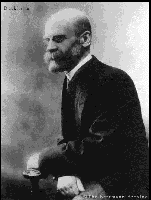
I. Society as moral reality
...A. society was an emergent moral entity
......1. sui generis – not reducible to any other explanatory level, eg, biological or psychological
......2. therefore sociology has to be its own discipline
...B. society is an organic whole that exists prior to and independently of individuals
II. The Division of Labor
...A. Major issue: what keeps society together, i.e., social solidarity
......1. how are individuals made to feel part of a larger social collective
......2. how are their desires and wants constrained in ways that allow them to participate in the collective
......3. how are the activities of individuals and larger units coordinated and adjusted to one another
...B. one answer is the collective conscience
......1. Throughout career Durkheim concerned with morality
......2. definition: the totality of beliefs and sentiments common to average citizens of the same society forms a
.........determinate system which has a life of its own”
.........a. people are born into a collective conscience
.........b. it regulates their perceptions and behaviors
......3. collective conscience varies by
.........a. volume—degree to which beliefs and sentiments are shared by members of a society
.........b. intensity—extent to which collective conscience has power to guide a persons beliers and sentiments
.........c. determinateness—degree of clarity of beliefs and sentiments
.........d. content—ratio of religious to purely secular symbols in the collective conscience
...C. Social morphology
......1. term used by Durkheim to refer to social structure
.........a. arrangement and interrelationships among parts
.........b. parts could be individuals or corporate units such as groups or organization
......2. social morphology has an effect on the collective conscience
...D. Mechanical and Organic solidarity
......1. typology of societies based on type of solidarity
......2. mechanical solidarity
.........a. small population
.........b. strong collective conscience
............i. strength of collective conscience dependends on
...............- volume of collective conscience relative to volume of individual conscience
...............- average intensity of states of the collective conscience
...............- precision (more defined) the consensual beliefs and practices
............ii. requires frequent contacts, strong associations with others, multiple occasions allowing for contacts
............iii. not much individual freedom
............iv. actions constrained by its dictates
.........c. division of labor simple
.........d. units based on similarity—resemblance as a cause of mutual attraction
.........e. best indicator of solidarity is legal code
............i. repressive and sanctions are punitive
............ii. reason: deviations are viewed as a crime against all members of society and the gods
......3. organic solidarity
.........a. population large
.........b. division of labor complex
............i. people have different specialized roles
............ii. many diverse structural units
.........c. collective conscience becomes enfeebled and abstract
............i. it does not vanish
............ii. people still realize they are members of the same society
.........d. problem: how is solidarity achieved in modern society
............i. mutual attraction through complementary difference
............ii. different parts need to cooperate in order to fulfill their function
............iii. collective conscience still strong enough that a basis of trust is formed even between competitors
.........e. again found in legal code
............i. law not punitive, but rather is restitutive (seeks to restore)
............ii. parties in contract trust that each will uphold its end of the bargain (“everything in the contract is not
...............contractual”)
............iii. example when you buy something over the internet with a credit card, you trust they the company will not
............... use your credit card number
............iv. thus altruism, not competition, holds society together
......4. why does the divison of labor become more complex
.........a. two factors
............i. moral density—number of people who have social ties to one another
...............- through development of nations, cities, communication and transportation
...............- internet?
............ii. social volume—population size
.........b. as moral density and population volume increases, division of labor becomes more complex
.........c. reason found in Darwin
............i. where competition is intense, diversity increases to reduce conflict
............ii. as moral density and social volume increases, similar functions competeàconflict
............iii. no option but to disappear or increase specialization
............iv. example: doctors in 19th century America
.........d. effect on collective conscience
............i. as social volume increases, population becomes more dispersed
............ii. collective conscience becomes weaker since conditions of life on not the same
.........e. seen in religion
............i. first gods are everywhere and in everything
............ii. eventually one God found only in heaven
............iii. polytheism to monotheism
.........f. as religion becomes more general, man becomes more rational
...E. Durkheim’s use of functions allows him to assess whether some part of society was functioning normally
......1. if a part was not functioning normally then it was pathological
.........a. thus the division of labor was supposed to promote social integration
.........b. Durkheim thus examines abnormal forms of the division of labor that are pathological
......2. 3 abnormal forms of the division of labor—discussion of two
.........a. anomic division of labor
............i. lack of normative regulationàindividuals feeling not attached to the collectivity
............ii. work becomes meaningless and alienating
............iii. unlike Marx, Durkheim did not consider this an inevitable consequence of capitalism
............iv. solution: greater state intervention in the economic sector or for occupational groups to become corporate
...............and develop a code of ethics like professions
.........b. forced division of labor
............i. overregulationàindividuals do not fit into the division where their natural abilities lie
III. Social facts
...A. definition—“ways of acting, thinking and feeling, external to the individual, and endowed
......with power of coercion, by which they control him.”
......1. this means that the focus of sociology is the morphological and symbolic structures people participate in
......2. external in two senses
.........a. individuals are born into a society with already constituted structures
.........b. even when individuals create organizations, norms and values they become an emergent reality that
............eventually becomes external to its creators
.........c. this becomes important in Berger and Luckmann
......3. constraining
.........a. compels certain actions, thoughts and dispositions
.........b. they impose limits and impose sanctions on those that go beyond the limits (“deviants”)
......4. social facts are internalized so that people want to do them to be part of the society
IV. Suicide as a social fact
...A. Suicides can be classified by the nature of the individual’s integration in society
...B. Two types of integration
......1. attachment
.........a. maintenance of interpersonal ties and perception that one is part of a larger collectivity
.........b. when fails egoism—excessive individualism in ways harmful to psychological well-being
........ c. opposite can occur—excessive attachments lead to no difference between the individual and the collectivity
.....2. regulation
........a. collective values and norms that limit individual aspirations and needs
.........b. when fails anomie
...C. Types of suicide
.....1. egoistic (underintegration)
.........a. “suicide varies inversely with the degree of integration of social groups of which the individual forms a part."
.........b. without group attachments life becomes meaningless
.........c. person commits suicide in a cold and rational way
...2. altruistic (overintegration)
.........a. results from too much attachment
.........b. person commits suicide for the good of the group
.........c. 3 types
............i. obligatory—individual obligated to commit suicide
............ii. optional—not obligated but customary to so under certain conditions
............iii. acute—killing oneself for the pure joy of sacrifice
......3. anomic suicide (underregulation)
.........a. lack of regulation
.........b. person no longer has the norms and values that limit aspirations and needs
.........c. more likely during prosperity than during depressed times
......4. fatalistic suicide (overregulation)
...D. how is suicide a social fact
......1. every society has a “normal” or average suicide rate
......2. when the rate exceeds the average too much a social pathology is the cause
.........a. what is affecting the attachment or regulation of the individual to the group
......3. suicide, like other forms of deviance, are normal for society